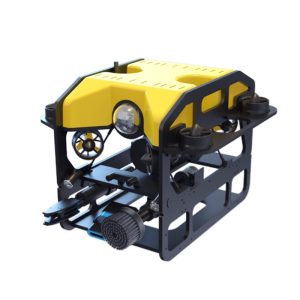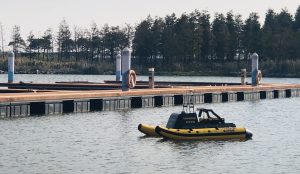
ROV (Remotely Operated Vehicle) refers to underwater robotic systems used for remote operations. For a comprehensive overview of its definition, classification, and technical history, please refer to the Wikipedia entry for ROV. This guide focuses on the architecture and core components of modern underwater ROVs. In this guide, you will learn what ROVs are used for, and what are they composed of.
Underwater ROVs, also known as underwater drones, or sometimes underwater robots, represent a crucial branch of the broader unmanned vehicle ecosystem that spans air, land, and sea. These intelligent submersibles can be equipped with cameras, tools, and sensors to perform a wide range of underwater operations—including visual inspection, sampling, and complex task execution—through remote control or autonomous navigation. Built on the same architecture and control systems as aerial drones, they are fully compatible with the MAVLink communication protocol.
Compared to traditional ROVs (Remotely Operated Vehicles) and AUVs (Autonomous Underwater Vehicles), modern underwater rovs are lightweight, portable, cost-effective, highly reliable, and user-friendly. These advantages make them ideal for applications such as underwater search and rescue, inspection of underwater infrastructure, pipeline and cable monitoring, and aquaculture. In recent years, they have also begun to replace heavy-duty equipment in subsea defense, offshore wind energy, oil and gas exploration, and oceanographic research.
As artificial intelligence continues to evolve, technologies such as image recognition, object tracking, path planning, route optimization, drone swarming, and data mining are reaching new levels of maturity. Seamless coordination between aerial, land-based, and underwater robots is becoming the norm. The upgrade toward intelligent systems is redefining workflows in defense, emergency response, surveying, and urban management. With highly customizable control systems, drones—both aerial and underwater—are becoming indispensable tools for professionals across various industries.
What are Underwater ROVs composed of
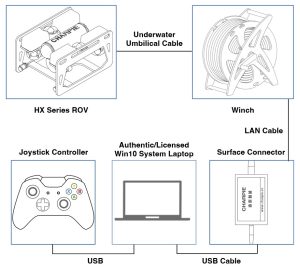
An underwater ROV system typically comprises the five major components as below: the topside control console, the submersible, the communication and power system, auxiliary tools and sensors, and user-defined modules.
1. ROV Topside Control Console
The topside control console serves as the command center and user interface for the underwater rov. It handles communications, live video feed display, and data storage. Essentially, it's a computer sending controlling commands to the submersible.
For general ROV operators, it functions as a remote controller and a UI screen with realtime video stream and ROV status data. For developers and advanced users, the topside computer inside the console provides capabilities for re-programming and system customization.
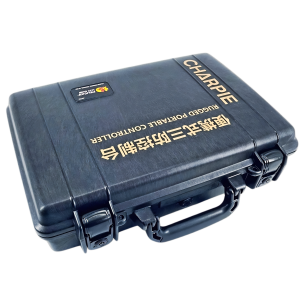
Tips: choose a topside control console with a bright screen (preferrably >1000 nits if budget allows) to get a better view outside. If you work in harsh environments, try the rugged portable controller in our store.
2. The Submersible Vehicle
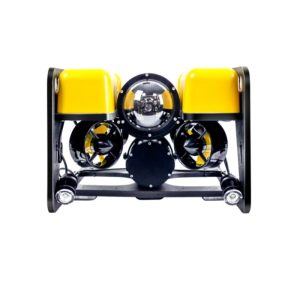
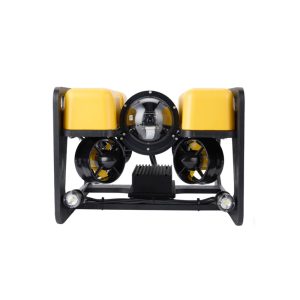
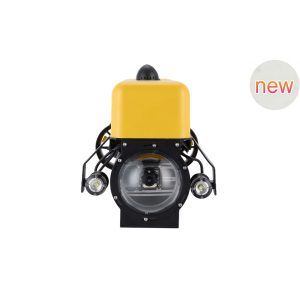
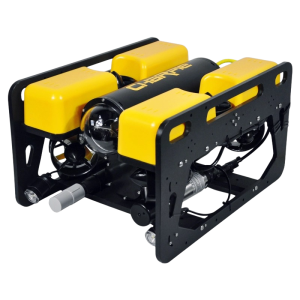
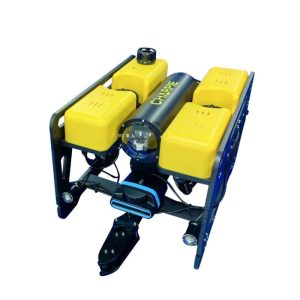
The submersible includes thrusters, an electronics cabin(with gimbal camera), LED lights, a battery cabin, buoyancy blocks (yellow part), and a shock resistant frame for protection. While standard configurations meet most operational needs, the system can be customized or upgraded. For example, more powerful thrusters for bigger payloads, larger battery packs for extended missions and extra cameras or sensors. Here is a quick selection guide when you choose among the 3 basic ROV models:
- Choose the battery powered submersible if you prefer local power supply or you need longer communication distance (> 300m). For a battery powered ROV, optical cable is configurable up to 2km and even longer.
- Choose the 220vac surface powered submersible if you need long operation hours underwater. Another advantage of a surface powered ROV is easier shipping and one also saves time for battery replacement.
- When tasks involve flooded tunnels or narrow pipelines longer than 500m, choose the mini ROV with optical cable. You can use it for any narrow entrance with DN> 300mm and total length up to 5km.
3. ROV Communication and Power
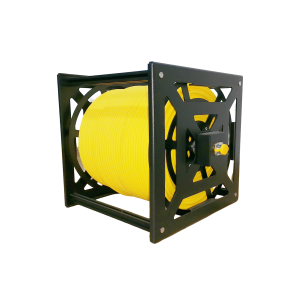
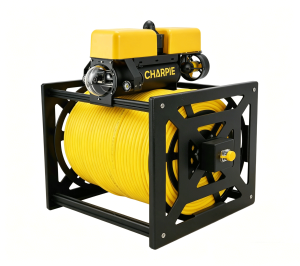
For battery-powered underwater ROVs, a neutral buoyant tether facilitates data communication between the topside and the submersibles. Typical cable lengths include 100m, 200m, and 300m. Longer-range operations require optical cables starting from 1000m, up to 5km.
At least two Li-ion battery packs are suggested for offshore works. You will find an extra battery pack of great help while working onboard. Prepare more if budget allows.
For surface-powered ROV systems (220VAC), the neutral bouyant tether cable need to provide both power and communication. This configuration supports longer endurance. However, as power requirements increase, cable diameter and spool size must increase accordingly.
For Mini pipe inspectino ROV, optical cables enable communication for water-filled tunnels or pipelines with length up to 5km. The miniature size of this ROV system fits into any pipes with DN>300mm.
4. Auxiliary ROV Tools and Sensors
Underwater ROVs can be enhanced with various tools and sensors such as: manipulating arms, sampling devices, cleaning brushes, sonar systems, water quality sensors.
These add-ons significantly expand the ROV's capabilities below the surface, making it a versatile tool for complex underwater tasks.
5. User-Defined Modules for ROVs
To meet unique project requirements, the underwater ROV can be equipped with customer-specified modules. User-defined mechanical interfaces, communication ports, and power supplies are available to support specialized applications and unlock new underwater possibilities.