
For modern subsea operations, establishing a stable, high-bandwidth underwater communication system is critical. Whether conducting deep-sea scientific research or long-distance pipeline inspections, selecting the right underwater long-range communication setup directly impacts data transmission speed, operator control, and mission success.
This guide explores primary underwater ROV communication methods, distance parameters, practical engineering pitfalls, and proven field architectures—from high-bandwidth optical fibers to cost-effective robot-buoy hybrid systems.
Primary Underwater ROV Communication Methods
Because high-frequency electromagnetic (radio) waves attenuate rapidly in water, choosing the correct physical layer is essential for subsea data transfer.
Underwater Communication Comparison
| Wired (ROV Systems) | Acoustic (AUV Systems) |
| • High Bandwidth (HD Video) | • Low Bandwidth (Telemetry/Control) |
| • Zero Latency Real-Time | • High Latency & Acoustic Interference |
| • Cost-Effective & Mature | • High Cost (Specialized Research) |
- Wired Communication (Tethers & Umbilicals): Remotely Operated Vehicles (underwater ROVs) rely primarily on physical tethers. Copper twisted-pairs or optical fibers support immense bandwidth—delivering multi-channel high-definition video, sensor feeds, and control signals with virtually zero latency.
- Acoustic Communication: Autonomous Underwater Vehicles (AUVs) frequently use acoustic modems. While acoustic signals travel several kilometers without cables, bandwidth is extremely limited. It is restricted to basic control telemetry, low-rate sensor logs, or emergency pings, and the equipment remains high-cost.
Underwater ROV Communication Distance & Bandwidth
Commercial underwater ROV systems achieve bidirectional, real-time control through specialized umbilical lines. Transmission distance varies drastically based on media type:
| Communication Technology | Transmission Distance | Bandwidth Capability | Typical Application Scenario |
|---|---|---|---|
| Power Line Communication (PLC) | 300 m – 500 m | 100 Mbps – 200 Mbps | Compact inspection ROVs using copper twisted-pair tethers |
| Standard Fiber Optic Lines | Up to 5 km | Multi-Gbps | Medium-to-heavy industrial inspection ROVs |
| High-Power Optical Transceivers | Up to 20 km | Multi-Gbps | Ultra-long pipeline internal inspection & deep-sea surveying |
| WDM (Wavelength Division Multiplexing) | Scalable over single fiber | Multi-channel expansion | Multi-sensor heavy-duty work-class ROVs |
For advanced deep-sea ROVs housing sonar, multi-beam systems, and 4K optical cameras, Wavelength Division Multiplexing (WDM) is applied. WDM transmits multiple data streams at distinct wavelengths over a single optical fiber strand, maximizing communication capacity without adding physical cable bulk.
Practical Pitfalls: Transmission Distance vs. Actual Working Radius
A common mistake in subsea project planning is assuming that a transceiver's nominal underwater communication rating equals the ROV's operational working radius.
In field deployments, several real-world factors reduce effective distance:
- Connector & Slip-Ring Losses: Signals pass through multiple physical junctions (penetrators, tether management system slip-rings, deck junction boxes). Cumulative decibel (dB) loss reduces total range.
- Thermal & Electromagnetic Interference (EMI): High-voltage power cables bundled alongside data lines in tight umbilical cores can generate EMI and thermal buildup.
- Power Delivery & Tether Drag: Driving power across kilometers of tether causes severe voltage drop. For extreme horizontal distances, relying entirely on surface-supplied power becomes impractical due to tether weight and thickness.
Proven Field Solutions for Industrial Applications
To address subsea distance limitations, custom-engineered communication and power architectures are required for complex operations.
Solution A: Ultra-Long Subsea Pipeline Inspection
- The Challenge: Inspecting tight internal pipelines across several kilometers horizontally without getting snagged or experiencing massive signal degradation.
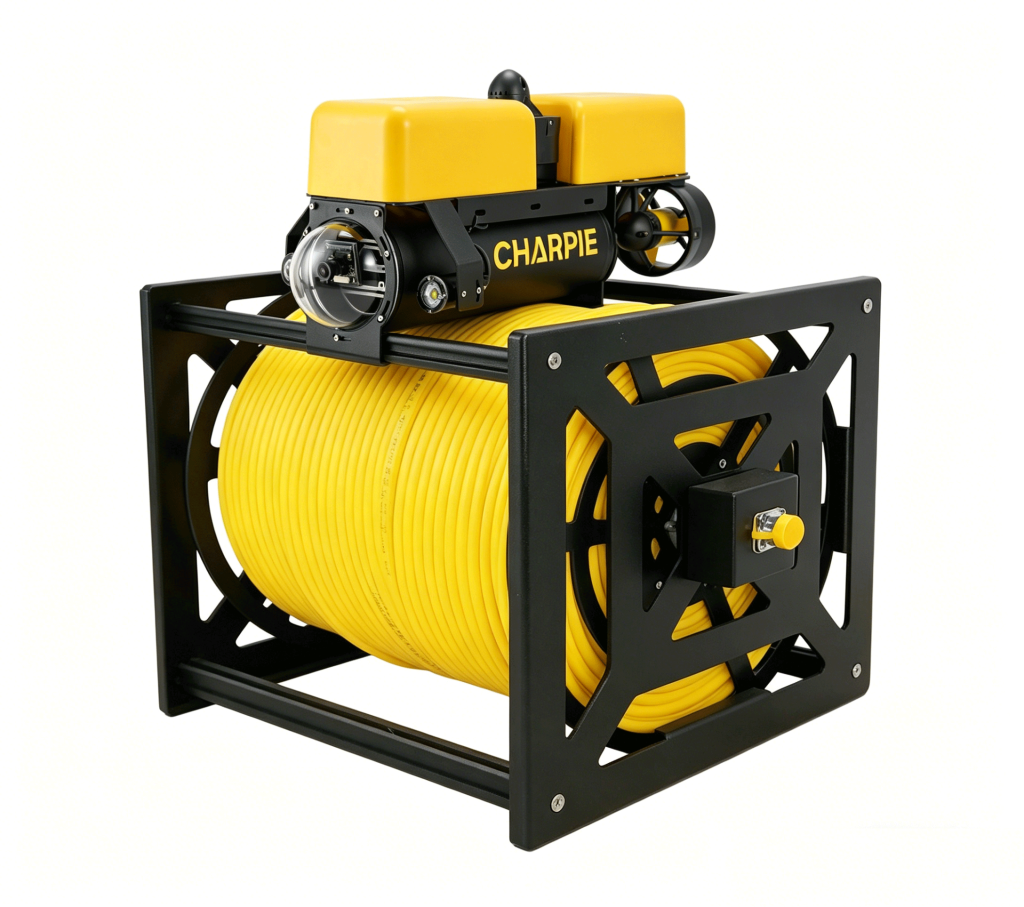
- The Architecture: A lightweight armored fiber-optic tether provides gigabit-level underwater long-range communication. To solve tether drag and voltage drop limitations over multi-kilometer runs, the underwater ROV uses on-board secondary lithium batteries for main propulsion rather than thick surface power conductors.
- Result: Successfully verified across 2km+ continuous runs inside pipelines down to 300mm in diameter, maintaining latency-free transmission for profiling sonar and HD video.
Solution B: Heavy-Duty Deep-Sea Work-Class ROVs
- The Challenge: Supporting dozens of high-bandwidth sensors (multi-beam, sub-bottom profilers, HD cameras) at extreme subsea depths under massive hydrostatic pressure.
- The Architecture: Full-link pressure-resistant optical sealing integrated with WDM. The optical channel remains continuous from the ROV frame, through the deep-sea umbilical winch, to the surface container control room.
- Result: Delivers standardized, ultra-deepwater connectivity capable of resisting extreme pressure and mechanical tension during heavy subsea operations.

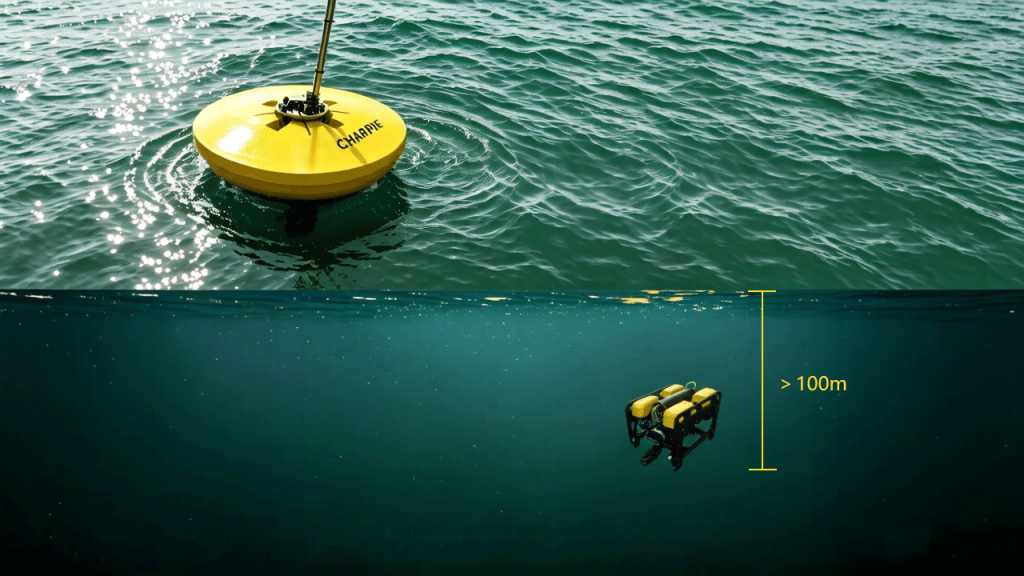
Solution C: Cost-Effective "ROV + Smart Buoy" Systems
- The Challenge: Expanding long-term coastal or off-shore observation radiuses without deploying massive surface vessels or ultra-long tether winches.
- The Architecture: A hybrid link combining wired subsea communication with wireless surface communication. A compact underwater ROV connects to an anchored surface buoy via a short tether. The buoy processes sensor feeds and relays them back to a shore base or vessel via high-bandwidth Wi-Fi or 4G/5G cellular links.
- Result: Drastically reduces equipment costs, simplifies deployment/recovery, and creates an economical platform for long-distance subsea monitoring.
Frequently Asked Questions (FAQ)
Q1: Why is optical fiber preferred over copper for long-range ROV communication?
Optical fiber offers near-zero signal latency, immune protection against electromagnetic interference (EMI) from high-voltage motor lines, and significantly higher bandwidth over distances exceeding 500 meters compared to copper cables.
Q2: How do you bypass voltage drop issues during long-distance ROV operations?
For extreme horizontal runs (such as long-distance pipeline inspections), using on-board battery power allows the ROV to carry a much thinner, ultra-lightweight optical tether—eliminating the weight and power attenuation of heavy copper power cables.