
Choosing the right power supply is a critical design decision when building or purchasing an underwater ROV. Because every subsea mission requires a unique balance of power, mobility, and endurance, identifying your specific operational requirements is essential to selecting the ideal underwater power system for your project.
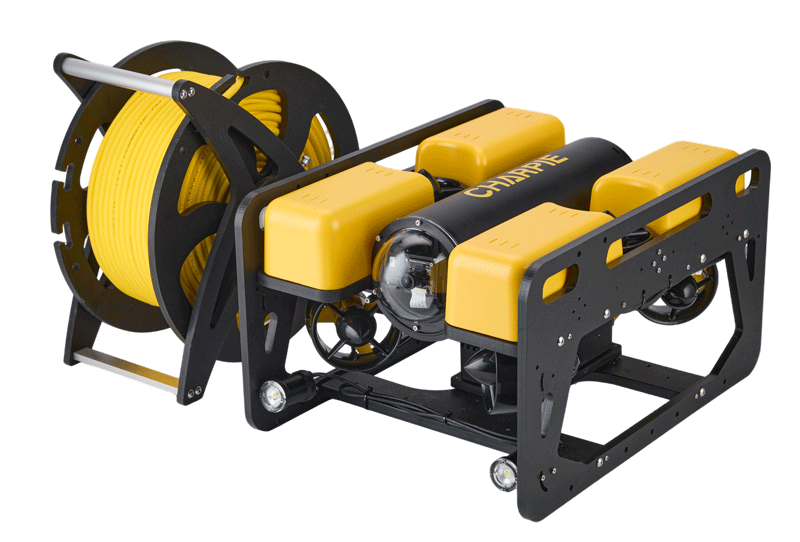
Here are several key factors to consider when building or purchasing an underwater ROV.
Underwater Mission Duration
Short missions such as inspections may only require small onboard batteries, while long-duration surveys may require tethered power or high-capacity battery systems.
Operational Range
If the vehicle must travel long distances in kms, untethered AUV systems are usually the best choice. Load the AUV with high-capacity battery module to ensure long inspection range. The battery powered tethered ROV system HX-300-B from Charpie, can be upgraded to operate as a cable-free AUV if flashed with autonomous inspection firmware.
Payload Power Requirements
High-power payloads such as:
- Multibeam sonar
- Manipulator arms
- High-intensity lighting
- Scientific sampling tools
may require tethered power systems.
Environmental Conditions
Complex environments such as wreck sites, offshore platforms, or subsea structures increase the risk of tether entanglement.
In such cases, untethered AUV systems may provide safer operations.
However, in complex missions such as maritime rescue or shipwreck exploration, operators onshore or on support vessels must make real-time tactical decisions based on live data and video feeds. In these scenarios, the non-real-time nature of AUVs fails to meet the immediate operational requirements of the site. Tethered ROV system are more preferable in these scenarios.
| Feature | ROV (Tethered) | AUV (Untethered) |
| Data Feed | Live/Real-time video & sensor data | Data often logged or delayed |
| Control | Direct human intervention | Pre-programmed/Autonomous |
| Risk | High risk of tether entanglement | High risk of limited adaptability |
| Best Use | Precision work & Rescue | Mapping & Long-range surveys |
Budget and Operational Cost, CPEX VS. OPEX
Battery-powered systems like AUV may have lower initial infrastructure costs, while tethered ROV systems may require surface vessels, winches, and tether management systems.
Understanding your operational requirements will help determine the best solution.
While AUVs require sophisticated onboard intelligence, they eliminate the need for costly Tether Management Systems (TMS) and heavy-duty winches, significantly lowering the barrier to entry for small-scale deployments.
ROV operations are often tied to the day-rates of specialized DP (Dynamic Positioning) vessels and require a full team of offshore technicians. In contrast, battery-powered AUVs can be deployed from simpler craft, reducing daily operational overhead.
| Cost Item | AUV (Autonomous, Untethered) | ROV (Tethered) |
| Capital Expenditure (CAPEX) | High (Includes AI, high-density batteries, and INS/navigation) | Moderate (Main costs are thrusters, frame, and cameras) |
| Auxiliary Systems | Low (Only requires basic launch and recovery frames) | Extremely High (Winches, TMS, control cabin, and high-voltage power) |
| Vessel Requirements | Minimal (Can be deployed from small craft, RIBs, or shore) | High (Requires large vessels with deck space and power supply) |
| Personnel Costs | Low (Usually 1–2 operators) | High (Team of pilots, navigators, and tether technicians) |
| Maintenance Costs | Battery replacement and sensor calibration | Frequent tether wear and connector waterproofing |
AUVs are for looking; ROVs are for doing.
| Scenario | Winner | Why? |
| Mapping 100km of Seafloor | AUV | Set it and forget it. |
| Inspecting a Bridge for Cracks | ROV | Need steady hovering and live HD zoom. |
| Closing a Subsea Valve | ROV | Need a robotic arm and real-time control. |
| Finding a Drowning Victim | ROV | Every second counts; need live video. |
| Deep Pipe/Tunnel Inspection | ROV | Need the tether to pull it back if it gets stuck. |
Honest opinion based on our experience: If you are in the business of Infrastructure, Public Works, or Emergency Response, the ROV is your primary tool. The AUV is just a fancy sensor-carrier for when you have a lot of empty water to cover.
Get 2 underwater robots for the price of 1. HX-300-B is sold as a tethered ROV with local battery power system yet can be upgraded to untethered AUV with a single firmware flash. It is an Open-Architecture Development Platform which can be used both tethered AND untethered. Once your code is mission-ready, simply flash your autonomous inspection program and detach the umbilical. Our hardware is designed to transition from a pilot-commanded ROV to a data-driven AUV without changing platforms.
Selection Guide: Matching Power Systems to ROV Applications
Now we are set with tethered ROV, we have to select the proper power system for it. Selecting the right tethered ROV power configuration is not only about vehicle design—it must also match the real operational environment and mission requirements. Different underwater tasks require different combinations of power supply, mobility, endurance, and communication capability.
For example, in industrial salvage or offshore platform work, where constant high-torque thrust is required to fight heavy currents, surface-powered systems remain the standard. However, for ultra-long-distance pipeline or tunnel inspections, a battery-powered ROV is the only viable solution, as it eliminates the tether weight and power loss that stop traditional ROVs at the 300-meter mark.
The table below summarizes several common underwater robotics applications and the recommended power solutions.
| Application | Recommended Power Mode | Why |
| Urban Water Pipeline (2 km+) | Portable Battery ROV | Eliminates Voltage Drop. Delivering power over 2km of thin cable causes massive resistance loss. Batteries provide 100% local power directly to the thrusters. |
| Rapid Ship Hull Inspection | Portable Battery ROV | Rapid Deployment. No need for a generator on a crowded dock; just "drop and go." |
| Deep-Sea Infrastructure | High-Voltage Surface Power | Infinite Endurance. If the mission lasts days or weeks, battery swaps are impossible at depth. |
| Offshore Platform | High-Voltage Surface Power | Max Thrust. Fighting heavy ocean currents and running cleaning tools requires more "amps" than a standard battery can sustain. |
Conclusion: Power Defines Capability
The power architecture of an underwater robot defines its operational limits. While surface-powered ROVs remain essential for high-torque intervention, battery-powered ROVs offer superior reach for long-distance (2 km+) pipeline inspections by eliminating voltage drop and tether drag. Our modular platform further bridges the gap for researchers, offering a seamless path from tethered safety to AUV autonomy.
Future Outlook: Toward Subsea Residency
The industry is moving toward "vessel-free" and permanent subsea operations:
- Subsea Residency: Next-generation systems will be permanently stationed in subsea docking stations, removing the need for daily launch and recovery from support vessels.
- Remote Operations: Leveraging subsea fiber optics and acoustic links, operators will conduct inspections from thousands of kilometers away via cloud-based control.
- Energy Autonomy: Integrated with fuel cells and renewable ocean energy, Resident ROVs will support months of continuous monitoring for offshore energy and environmental protection.